The past few weeks have been laden with stalemate televised debates and numerous candidates getting kicked off of campaigns for social media faux-pas. In what little debate there has been about larger issues affecting Canada’s future, young people have been routinely left out of the conversation. The youth voter turnout rate is notoriously low and little has been done by any of the political parties to reverse the dire numbers from the 2011 election. “By being disengaged, they have now become conveniently ignorable,” reads a scorning Globe and Mail editorial.
But Canadians aged 15 to 29 make up a fifth of the Canadian population. That’s more people than Toronto and Montreal combined. With the federal election around the corner, we see an opportunity to have a meaningful conversation about the future of Canada.
Enter Possible Canadas, a journalism project we produced in collaboration with the J.W. McConnell Family Foundation. We recruited ten exceptional student journalists from across western Canada asked them: “what conversations can you spark throughout your university campuses and beyond by asking your peers one question: what do we want Canada to be?”
We’re very excited to announce the ten student journalists that are working with us to change the narrative around youth engagement with politics. The fellows will complete ten days of intensive reporting on election issues that matter to their campus community.
We’ll publish the resulting impact-oriented pieces online and in syndication with professional media outlets.
Stay tuned! Possible Canadas will be live on October 22nd.
Meet the fellows:
“Good journalism is centered on an earnest search for the truth presented to the public and should come from a diverse range of voices, students included.”– Arno Rosenfeld
Fourth-year political science student, University of British Columbia, journalist at the Ubyssey
Arno’s question: What will Canada look like in 20 years?
“Student papers, funded by students rather than a shifting subscriber base, have numerous opportunities: to directly ask students what they want; to find original angles through engaging with their community instead of applying national media narratives; to set up events that guide and open up conversations about politics, creating a more informed student population.”-Michael Scoular
Fourth year English student, University of the Fraser Valley, journalist at the The Cascade
Michael’s question: Are we teaching students enough about the political system?
“I’ve always viewed the campus experience as a microcosm of the broader world: get the people in power to change their minds, and necessary policy changes will follow.”– Christopher Adams
Fourth year Political Science, University of Calgary, journalist at the Gauntlet
Chris’ question: How to reconcile different perspectives in the climate change debate?
“I am passionate about the role that journalism can play in challenging authority, exposing ineffective bureaucracy, and giving a voice to underrepresented opinions.”– Michaela Slinger
Third year student of Psychology, Education and Journalism at Quest University
Michaela’s question: How can we engage more young people to vote?
“If we can get post secondary students to even begin reading political coverage, we need to make it quick. Straight to the point, basic, blunt stories about what the problems are and what the leaders are planning on doing about it.”– Chandler Walter
Journalism student, Langara College, journalist at The Other Press
Chandler’s question: How much does the burden of financial stress limit post secondary students, and what could a Canada look like in which that burden is non‐existent?
“Young people want to be educated about policy in Canada but are overwhelmed with conflicting information. Student journalists have an opportunity to reach out to these young people and make politics simpler, even fun to indulge in, which results in constructive conversations about the future of Canada.”-Josie Lukey
Third year journalism and political science student, Mount Royal University, journalist at J-Source.
Josie’s question: What would a more humanized political system look like?
“In a world where most news sources cater to students’ parents’ generation and refer to millennials in the third person, student journalism provides a forum for young people to be heard and an opportunity to make students understand the realities of their peers.”– Kate Black
Fifth year student of Women’s and Gender Studies and Political Science, University of Alberta, journalist at The Gateway
Kate’s question: What will universities have to do to advance reconciliation between indigenous and settler Canadians?
Photo credit: Angelique Rodrigues
“Politicians need to be reminded that they’re accountable to Canada’s students too.”– Alexander Kim
Master’s of Journalism student, UBC, host and producer of Theoretically Speaking from @CJSW
Alexander’s question: What can students do to enlist radical changes in media for Canada’s future?
“This generation is looking for ways to make informed decisions, but a lot of information is inaccessible to them because of the lack of context and the sensational tone that it takes.”– Kevin Rey
Second year student, Master’s in Molecular Biology and Biochemistry, Simon Fraser University, journalist at The Peak
Kevin’s question: What do statistics tell us about the current state of Canada?
By way of a brief introduction, I am spending two months at Discourse Media as a research intern. The university I attend—Quest University Canada—requires its students to design and complete a minimum of one class of experiential learning in pursuit of their Bachelor’s Degree. (DM co-founder Erin Millar also happened to teach me journalism this past fall at Quest!) Throughout my internship here I am writing a series of reflections, shared here as blog posts. This first post addresses one of the key questions I had hoped to explore coming into this internship: How can journalism promote more active citizenship?
Here I am at last, a research intern at Discourse Media. The good thing is that after a week of working in this real and adult world of journalism, I am not rolling my eyes at the thought of addressing this question: How can journalism promote more active citizenship? A combination of researching best practice examples of cross-border, cross-organization journalistic collaborations (who even knew such a thing existed?) and peppering my ever-patient colleagues with questions about everything media has brought me to two core thoughts on the matter.
The first thing journalism must do in order to promote active citizenship is think about how it will promote active citizenship. Ha! It sounds ridiculous in its obviousness. But when I saw it unfold before me on a white board this past week, what seemed ridiculous was how seldom I had done this kind of deliberate and concerted thinking.
Here is how Erin Millar, co-founder of Discourse Media, explained it to me—whiteboard sketch and all. Journalists do the work of reporting and researching. They read things, take notes, interview people and analyze data. The traditional output of this process is an article, in which they include some of the key quotes and figures they gathered during their reporting. The output doesn’t have to be an article—it could be an infographic, a podcast, a short film—but for the sake of this explanation, it is.
Once it’s out circulating in society, an article might have some kind of impact. If it’s a speaking-truth-to-power journalism article, perhaps it will result in a policy change, or at least some serious pressure for one. If it’s an empathy-inducing expose, perhaps it will encourage people to be kinder to their neighbours. There are myriad possible impacts a journalistic output could have, and a more active citizenry is one of these. So often though, for me at least, these impacts have been hypothetical ideals—”perhapses” and “I hopes.” If journalists were to consider impact first and then work backwards to designing an output, impact would be far less a matter of chance. Call it impact-oriented, strategic journalism, or something less jargonistic if you can think of it.
My second thought is that if journalism is to encourage active citizenship—or have any number of other desirable impacts—it must be read. And, really, read pretty widely. Otherwise it’s just scrap paper, or the digital equivalent.
Ensuring that potentially impactful journalism gets read requires thinking of it like a product, which must be effectively distributed and marketed. It requires creating a demand by convincing audiences that quality journalism is a good they need. If this sounds like economics, that is the point. Journalism needs to take capital-B Business seriously if it is to thrive. (I am saying all of this as someone who literally shivers at the thought out doing an MBA.)
As a journalist I have been pushed to think of impact earlier and more deliberately, and I’ve been shown the importance of thinking like a business person—at least some of the time. Does the output I am proposing have a chance of promoting more active citizenship? If not, what could? Then, crucially, is anyone going to actually read/see/listen to what I’ve written/filmed recorded? How can I make sure that they do?
As per usual, a question has led to ten more. But hey, that’s getting somewhere.
We’re thrilled to share that Moving Forward, our data-journalism project about transportation in Metro Vancouver, is a finalist for the international data journalism awards awarded by Global Editors Network!
The awards celebrate work in the field of data journalism in media worldwide. They reward examples of data-driven investigations, applications, visualizations and storytelling, which cover matters relevant to society and aim to have an impact at a societal level.
With nearly 500 submissions, Moving Forward was selected among 78 finalists. Being included in a pool of candidates including multinational newsrooms like the BBC, Al Jazeera and CNN feels like success enough to us, but we’re incredibly excited for the results June 18th.
We created MovingForward because in the midst of a highly politicized transportation funding referendum in Metro Vancouver, journalists had little access to usable data and information about the transportation system. The result was conflict and opinions-driven news coverage in the media, and a general public that was ill-informed about the issues they were voting on.
In response, we obtained, crunched and published datasets available nowhere else (including TransLink’s financial data over time) that shaped journalists’ reporting. Our work generated stories in the Vancouver Sun, News 1130, CTV, the Tyee, Spacing, the National Post, Atlantic Magazine and others. We reached as many as 10,000 people a day through our website, and thousands more through our data interactives embedded in media outlet websites. We triggered thoughtful conversations on complex issues such as how to think about the full cost to ourselves and society of our transportation choices.
Thanks so much to all of you who supported us and our project, for more information about our nomination please visit the GEN website.
Next month, citizens of Metro Vancouver will be asked to make a decision that will radically shift the future of the region. The outcome of the referendum on funding improved transportation infrastructure and maintenance will impact the economy and urban development for decades, changing how we work and move through the region.
But what does that really mean? How will this, in the most concrete way, affect our lives?
We’re told many different things by the yes and no campaigns, but actually understanding how the outcome of the vote will change our region is a daunting and complex feat. And, so far, news media haven’t provided much insight beyond reporting on the competing claims of those with a vested interest in the outcome. Despite some laudable efforts to break down the issue for readers in an evidence-based way, the coverage is dominated by opinions and reporting on the politics of TransLink’s leadership.
For example, let’s take a look at the coverage on one day, February 19. Here are some headlines: “Only BC Transportation Minister Todd Stone can fire TransLink’s appointed board” (Surrey North Delta Leader). “Yes or no, TransLink needs fixing”(Tri-Cities Now). “City to spend $20,000 to sell Yes campaign”(Royal City Record). “High school student urges voters to say YES in transit plebiscite”(CKNW 980 Online). “Mayor Derek Corrigan says he will likely vote no”(CBC Radio One). The Vancouver Sun, the closest thing we have to a regional newspaper of record, published an editorial by Stephen Hume titled “Facts don’t support anti-Translink ranters.” The headline almost makes it sound like the piece might get beyond opinions by analyzing evidence, but it only deals with the compensation of Translink’s executive.
This sort of reporting is important; we need journalists to hold highly paid bureaucrats to account and to report on the opinions of Burnaby’s mayor or CKNW’s high school student. But none of this offers a deeper understanding about what transportation in the region looks like or what we stand to gain or lose by the outcome of the referendum. We believe journalists have a responsibility to inform our readers about the complexities of the system and issues, and so far we’re falling short. There are so many claims made by those on the yes and no side, and we need clear-eyed, evidence-based investigations of those.
(I should note that this problem also lies with TransLink itself, which, as a public body, is not as forthcoming with data as it ought to be.)
We think there is a desperate need to dig beyond the politics and opinions into the messy, complex data that describes how our transportation system functions and how it might change in the future. So for the past few months we’ve been working hard to obtain data about the system and collaborating withsmart data scientistswho understand complex statistics and modeling in order to produce content that make the complex system understandable to normal people. We will launch the project, which we’ve dubbed Moving Forward, on March 10 on a dedicated website and in partnership with media outlets.
We’re inspired by the great data journalism being done by projects like FiveThirtyEight and the Guardian’sDataBlog. The first phase Moving Forward will dive into questions including: Where does the revenue to fund transportation come from? What trends are impacting those sources of revenue, and why do we need a new source of revenue? How do people move through the region? What research exists about how that might change with the proposed investments? How much does it actually cost to travel from point A to B by different modes, and who pays? We’re producing animated videos, written articles, infographics and interactives in an effort to make the available data meaningful to regular people.
This is why we’re asking for your support to make Moving Forward happen. In order to stay true to our editorial vision, the project need to be independent. We think people in the region want this sort of evidence-based reporting, and we want to show our colleagues in media that our audience will support independent, clear-eyed data journalism.
Please visit our Indiegogo campaign to contribute.
As Ashoka Canada’s first Storytellers-in-Residence fellows, we will conduct a three-month research project about how more collaborative approaches to journalism can improve coverage of solutions
When we launched Discourse Media almost one year ago, we had a lot of questions.
We had a hunch that a more collaborative approach to journalism would enable us to do a better job of reporting on potential solutions to major problems. We felt this concept applied to all levels of the journalistic process: reporting, engaging audiences and the ever-ominous funding question.
The most innovative sectors of every field are achieving results through more and more collaboration. Why shouldn’t journalism be the same?
What we didn’t know, though, was how to go about that in a way that was in line with our values. As journalists, we typically keep our sources distant. That arms-length relationship protects our autonomy and the authenticity of our work. How could we embed ourselves more deeply in innovative projects or organizations while maintaining autonomy? Could this happen genuinely? What did it look like on the ground?
The same questions loom over the funding piece of the equation. Marked shifts in how journalism is paid for are underway. Sponsored content is on the rise. Increasingly, philanthropic organizations are funding journalism. (According to the fascinating report Growth in Foundation Support for Media in the United States, media grants in the U.S. increased by 21 percent between 2009 and 2011, even though the number of organizations funding media remained the same.)
While we see promise in media organizations forging new revenue sources, we wondered about impact of this trend on what we report on and how. Is there risk in tying journalism to volatile funding cycles driven by the interests of philanthropic organizations?
Over the past year we’ve scratched the surface of some answers to these questions. We’re over the moon that now, thanks to a generous grant from the Ashoka Canada (irony noted), we will be able to explore deeper and engage in a broader conversation.
This month, Discourse Media was awarded the first ever Ashoka Storyteller in Residence (STiR) Fellowship in Canada. This fellowship will support us in conductinga three-month research project on how traditional and start-up media organizations in Canada and elsewhere are integrating collaborative, solutions-oriented journalism frameworks into their current models, and how we can better collaborate to improve journalism about solutions.
STiR, which existed in Europe before launching in Canada this year, has until now supported individual journalists. This time around, Ashoka decided to take us on as a team and allow us to take a different approach: a solutions-oriented look at solutions-oriented journalism, if you will.
Over the next few months, we’lltalk with journalists, NGOs, social entrepreneurs, newsroom editors, members of the private sector and many others about their experiences with collaborative approaches to improving journalism, and what we can do to make collaborations more likely, fruitful and effective. We’ll publish our findings this spring.
I like to think of Discourse Media as a laboratory in which to experiment with new ways of doing journalism to improve reporting on solutions. Over the past year, we’ve learned a lot from these experiments. What would happen if we embedded two journalists at a gathering of civic innovators? (The Doable City Reader.) Could we create independent journalism while working directly with a client sponsoring our content? (The Spirit of Discovery.) How could we tell a story about schools all over the world working together to improve schools? (Deeper Than Knowledge.)
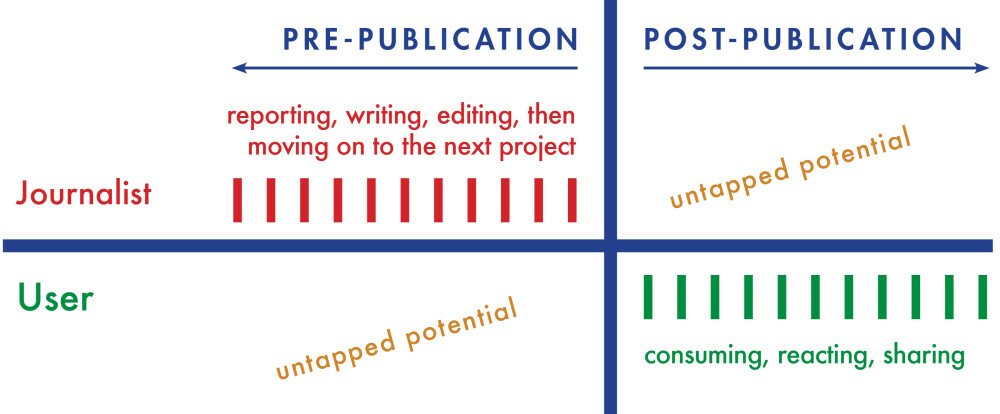
Meg Pickard, former head of digital engagement at the Guardian, developed this diagram to describe opportunities to better engage with our audiences.
The thread that ties all these projects together is collaboration. We’ve partnered in new ways (new for us, anyways) with funders, sources and media organizations. But one group we haven’t yet found a way to partner with in a meaningful way is our audience. How can we better engage regular people and communities in our reporting at every stage?
So when I was introduced to Andrew Haeg, entrepreneur-in-residence at the Center for Collaborative Journalism, I felt like I had hit the jackpot. Andrew is founder of Groundsource, a new digital engagement tool for journalists and researchers designed to capture communities’ voices (particularly underrepresented ones).
In a piece published on Medium, Andrew explains: “We need to create a place that affords privacy but retains accountability. One that’s for more than just venting — a place to communicate problems and observations with an expectation of being heard. This could be the platform for a new journalism based on trusted values. … [We] need to connect the view from the ground with the view from above to tell true, human stories in context.”
Andrew’s words resonated with me because if my goal was to produce journalism that contributes to positive change by telling stories about solutions, I better understand the problems from a normal person’s perspective. I needed a better way of listening to communities’ stories, hopes, frustrations, vision, needs, questions and so on. Too often we journalists listen only to the typical sources (experts and leaders) or the loudest community members. For example, when reporting on school change, it’s easy to seek out the perspective of the teachers’ union or the education minister or the most pissed-off parent. But what about normal kids and parents? What about regular teachers? Can Groundsource seed a virtual network that is to me, the education journalist, what the police station is to the crime reporter?
Groundsource intersects with the concept of the “listening post”, developed by NPR’s VP of diversity in the early 2000s and it is all about creating a place (whether physical or virtual) where community members express their voice and are treated by journalists as a legitimate news media source.
The aim is to shift the flow of information between community members and journalists. The traditional “broadcast model” involves journalists gathering information from the typical sources that already have authority (or the loudest community voices) then publishing the work and moving on to the next project while the community of readers then read, share and debate the product in isolation from the journalist — so, primarily one-way communication. I believe that we journalists ought to make better use of the expertise of community members’ lived experience. I see promise in a model that engages community members in shaping reporting pre-publication and builds a meaningful relationship between journalist and community post-publication. The above diagram (developed by Meg Pickard) captures this concept nicely.
Over the next few months, we’ll be exploring ways to apply these concepts to our journalism − and cooking up some new experiments in the lab. In the meantime, I’llleave you with a quote from this article about WBEZ’s Curious City journalism project in Chicago: “When we [journalists] build with our communities we build space for more people to shape our stories and cultivate a sense of ownership over the process. This shifts to locus of journalists’ authority from the act of publishing to the process of engaging. It makes journalism more accountable and more valuable.”
For over a year and a half now, Discourse Media co-founder Erin Millar has been chomping at the bit to find a way to document, over time, the journey of a three-year global project called New Pedagogies for Deep Learning, which is aimed at transforming education into something more relevant to the average student’s life. The challenge for us was to figure out how to produce a journalism product that would unfold over time, chapter by chapter, in real time, while capturing the pursuits of thousands of educators and students in countries around the world.
The story Erin (who’s been writing about education for over a decade) wanted to report is just beginning, so how could we create a piece of work without an ending?
We found inspiration in recent approaches that leading newsrooms have taken to adapting long form journalism to the digital age. Multimedia documentaries like the New York Times’ Snowfall, the Guardian’s NSA Files: Decoded, or the Globe and Mail’s No Safe Use give us hope that, despite the many challenges the digital era is presenting the journalism industry, newsrooms are harnessing opportunity and creating a wholly new form. Works like those mentioned above make it clear that the best news organizations will be relevant amidst the upheaval.
This new form of digital journalism inspired our response to the challenge of reporting on NPDL. We’re excited to announce the publication of the first chapter in the story: Deeper Than Knowledge.
Deeper Than Knowledge is also inspired by the work of the Solutions Journalism Network. Our vision was to document this network of schools attempting to change in a critical way that dug into the barriers and impact of promising solutions. We wanted to show the messiness of change over time.
Future chapters are in the works. We’d love to hear your thoughts.
 “Good journalism is centered on an earnest search for the truth presented to the public and should come from a diverse range of voices, students included.”– Arno Rosenfeld
 “Student papers, funded by students rather than a shifting subscriber base, have numerous opportunities: to directly ask students what they want; to find original angles through engaging with their community instead of applying national media narratives; to set up events that guide and open up conversations about politics, creating a more informed student population.”- Michael Scoular
 “I’ve always viewed the campus experience as a microcosm of the broader world: get the people in power to change their minds, and necessary policy changes will follow.”– Christopher Adams
 “I am passionate about the role that journalism can play in challenging authority, exposing ineffective bureaucracy, and giving a voice to underrepresented opinions.”– Michaela Slinger
 “If we can get post secondary students to even begin reading political coverage, we need to make it quick. Straight to the point, basic, blunt stories about what the problems are and what the leaders are planning on doing about it.”– Chandler Walter
 “Young people want to be educated about policy in Canada but are overwhelmed with conflicting information. Student journalists have an opportunity to reach out to these young people and make politics simpler, even fun to indulge in, which results in constructive conversations about the future of Canada.”-Josie Lukey
 “In a world where most news sources cater to students’ parents’ generation and refer to millennials in the third person, student journalism provides a forum for young people to be heard and an opportunity to make students understand the realities of their peers.”– Kate Black
 “Politicians need to be reminded that they’re accountable to Canada’s students too.”– Alexander Kim
 “This generation is looking for ways to make informed decisions, but a lot of information is inaccessible to them because of the lack of context and the sensational tone that it takes.”– Kevin Rey